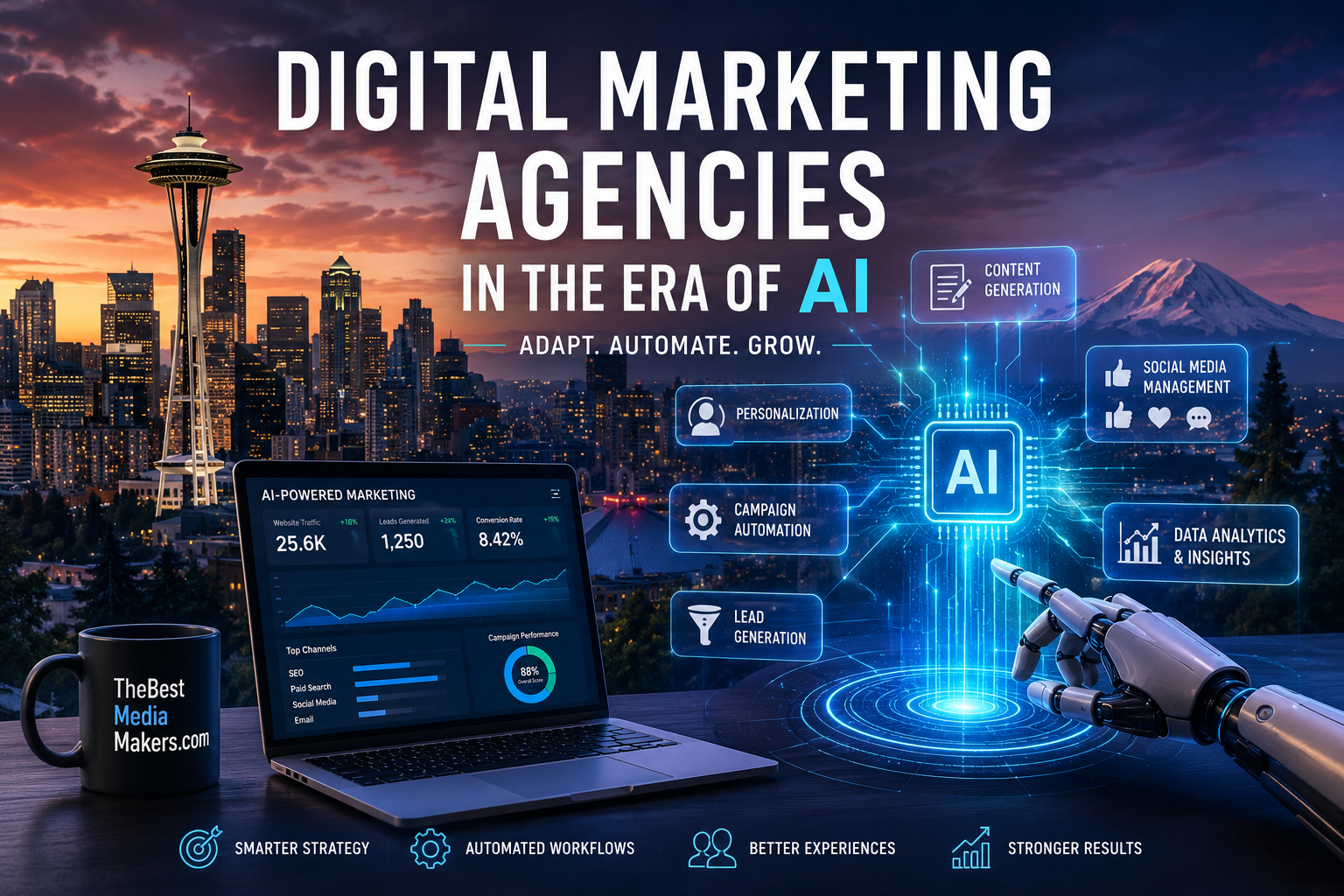
Digital Marketing Agencies in the Era of AI: Adapt, Automate or Get Left Behind
For years, digital marketing agencies have helped businesses navigate websites, Google, social media, SEO, email campaigns and online advertising.
Now the industry is facing a much bigger transformation.
Artificial Intelligence isn’t simply adding another tool to the digital marketer’s toolbox. It is changing the toolbox itself.
Generative AI can create copy, images and video in seconds. AI can analyse customer behaviour, personalise communications, optimise campaigns and increasingly coordinate entire marketing workflows through AI agents.
The question is no longer whether digital marketing agencies will use AI.
The question is:
What will a digital marketing agency actually be needed for when AI can perform much of the traditional work?
From Digital Agency to AI-Powered Growth Partner
Traditional agencies often sell services individually:
SEO.
Social media management.
Content creation.
Email marketing.
Google Ads.
Website management.
The AI-driven agency combines these activities into an interconnected system.
Imagine a small business with an AI-powered marketing operation running continuously:
Website Visitor → AI Chat/Voice Agent → Lead Qualification → CRM → Personalised Follow-Up → Email/SMS → Social Content → Appointment → Analytics → Campaign Optimisation
Instead of manually moving information between different platforms, automation connects them.
The agency’s role consequently changes from simply creating marketing content to designing and managing an intelligent marketing ecosystem.
Content Creation Has Changed Forever
One of AI’s most obvious impacts is content production.
A marketer can now use generative AI to help produce:
- Blog articles
- Social media posts
- Advertising copy
- Email campaigns
- Images and graphics
- Short-form videos
- Product descriptions
- Landing-page content
- Campaign variations
This doesn’t mean creativity has become irrelevant.
Quite the opposite.
When almost anyone can generate content, original ideas, brand identity, credibility and human judgment become more valuable.
The competitive advantage shifts from:
“Can we create content?”
to:
“Can we create the right content, for the right audience, at the right moment—and prove that it works?”
Research published in 2026 points in this direction: marketing organisations are increasingly exploring AI for scaled creativity, personalisation and continuous optimisation rather than treating it only as a writing assistant.
Personalisation Moves to Another Level
Traditional digital marketing frequently divides customers into broad groups.
AI makes much more granular personalisation possible.
Two people visiting the same website could potentially receive different recommendations, messages, offers and follow-up communications based on their behaviour and context.
Instead of:
One campaign → thousands of customers
marketing increasingly moves toward:
Thousands of customers → thousands of tailored experiences
AI-driven personalisation can combine customer data, behavioural signals, content generation and automated decision-making to create more relevant interactions at scale.
For agencies, this creates an enormous opportunity—but only if they understand data, integrations and automation as well as advertising.
Enter the AI Marketing Agent
The next major change goes beyond generative AI.
It is Agentic AI.
A generative AI tool waits for someone to ask it to perform a task.
An AI agent can potentially be given an objective and then perform multiple connected actions to achieve it.
Consider an AI marketing agent instructed to:
“Generate more qualified leads for our business.”
Within appropriate human-defined permissions and controls, an AI-enabled workflow could potentially:
- Analyse campaign performance.
- Identify poorly performing content.
- Generate alternative advertising copy.
- Create social media content.
- Personalise follow-up messages.
- Update lead information.
- Trigger CRM workflows.
- Analyse engagement.
- Recommend campaign changes.
- Report results to the business owner.
Agentic AI is increasingly being explored as a way to coordinate content, media, personalisation, experimentation and optimisation across marketing workflows.
This could dramatically change the economics of running a digital marketing agency.
Small Businesses Could Be the Big Winners
Historically, sophisticated marketing automation was easier for large organisations with substantial marketing teams and technology budgets.
AI is beginning to reduce that barrier.
A small company may not be able to employ:
Marketing Manager + Copywriter + Social Media Manager + Video Editor + Data Analyst + Receptionist + Lead Qualification Team
But it may increasingly be able to create a digital workforce in which people work alongside specialised AI agents and automated workflows.
That doesn’t necessarily eliminate people.
It changes where people add the most value.
AI handles repetitive execution and analysis while people concentrate on strategy, creativity, relationships, judgment and decision-making.
Search Is Changing Too
There is another transformation agencies cannot afford to ignore.
For decades, digital marketing revolved heavily around getting customers to click:
Google → Search Result → Website → Conversion
AI assistants are changing that journey.
Consumers can increasingly ask an AI system:
“What’s the best solution for my problem?”
and receive a synthesised answer or recommendation without following the traditional search journey.
Research in 2026 indicates that advertisers already see AI reshaping product discovery and consideration.
That means agencies increasingly need to think beyond traditional SEO.
Businesses will need content that is understandable, credible and useful not only to search engines and humans, but increasingly to AI-powered discovery systems.
The future could therefore combine:
SEO + Content Authority + Structured Information + Brand Trust + AI Discovery Optimisation
Will AI Replace Digital Marketing Agencies?
Some agencies probably will disappear.
But not simply because AI exists.
They will disappear because competitors learn how to use AI better.
Agencies whose main value proposition is producing basic posts, generic articles or simple advertisements will face increasing pressure because AI can dramatically accelerate these tasks.
The stronger agency of the future will provide something different:
Strategy + Creativity + AI + Automation + Data + Integration + Human Oversight
And importantly, agencies still need humans to decide what should be automated and what should not.
Brand reputation, privacy, copyright, inaccurate AI-generated information and inappropriate automated decisions all require governance and oversight. Generative AI introduces genuine intellectual-property, bias and brand risks, making human supervision important.
The Rise of the AI-First Digital Agency
The digital marketing agency of tomorrow may look less like a traditional advertising agency and more like a technology-enabled growth partner.
It won’t just ask:
“What should we post on Facebook this week?”
It will ask:
“How can we build an intelligent system that continuously attracts, engages, qualifies and converts customers?”
That is a fundamentally different proposition.
And it requires agencies to develop skills beyond traditional marketing—including AI agents, workflow automation, APIs, CRM integration, analytics, prompt engineering and AI governance.
The Future Is Human + AI
The biggest mistake is viewing this transformation as:
Humans vs AI.
The more useful model is:
Humans + AI + Automation.
AI provides speed.
Automation provides scale.
Data provides insight.
Humans provide strategy, creativity, judgment and trust.
The digital marketing agencies that successfully combine all four could become significantly more capable than the traditional agencies they replace.
AI isn’t the end of digital marketing agencies.
It may be the beginning of an entirely new kind of agency.
TheBestMediaMakers.com
At TheBestMediaMakers.com, we explore how AI, automation and emerging digital technologies are reshaping marketing, content creation and the way businesses connect with their customers.
The future of digital marketing isn’t coming. It’s already being built.
Leave a Reply