
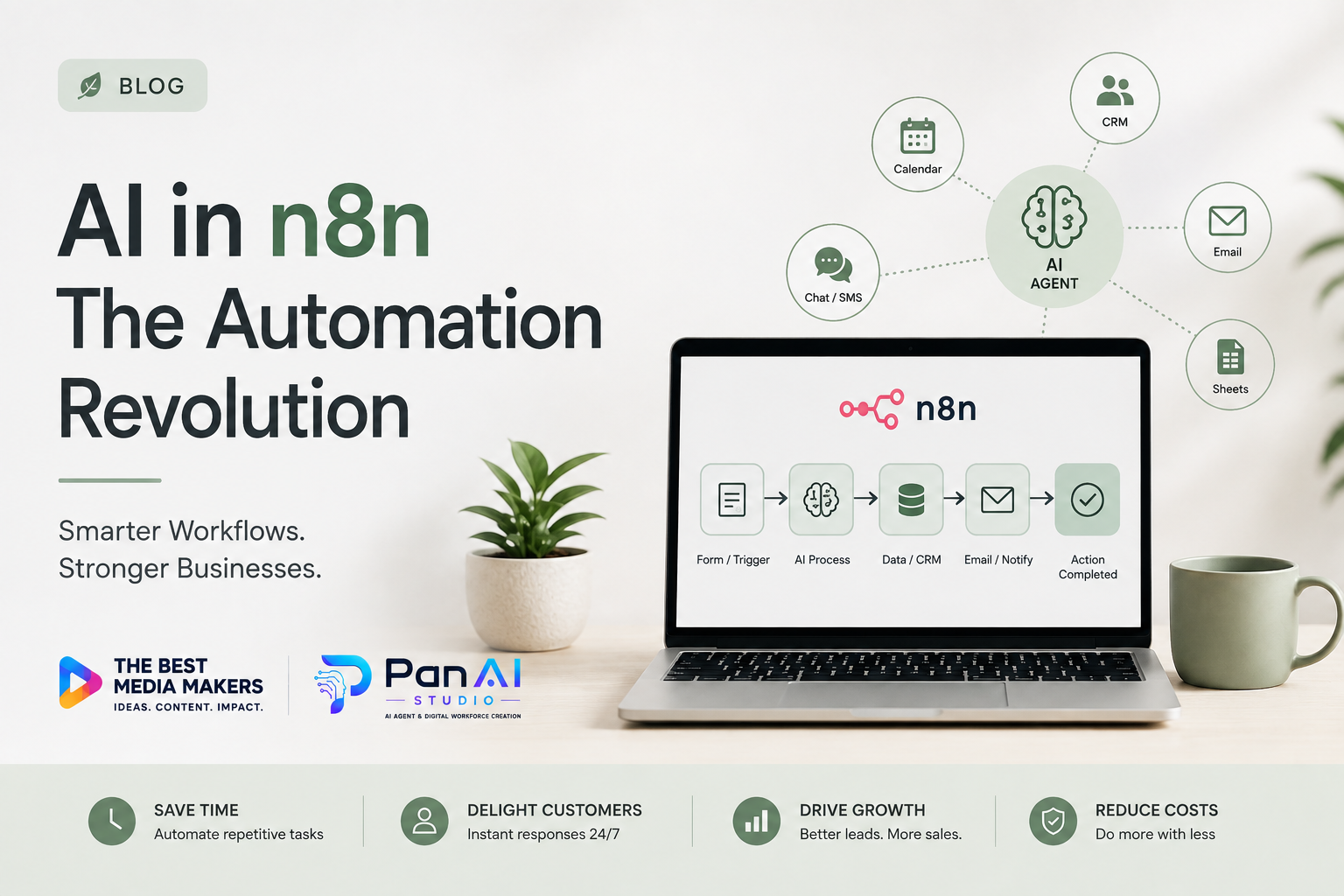
AI + n8n: The Automation Revolution That Could Change How Small Businesses Work
What happens when artificial intelligence stops simply answering questions—and starts doing the work?
That is where platforms such as n8n are becoming particularly interesting.
AI can write an email, analyse information, generate content or answer a customer question. But connect AI to business systems, databases, calendars, email, CRMs and social media, and something much bigger happens.
AI becomes part of the workflow.
And that could fundamentally change how small businesses operate.
What Is n8n?
n8n is a workflow automation platform that allows different applications and services to communicate with each other.
Think of it as the digital nervous system of a business.
A customer submits a form.
n8n receives the information.
AI analyses the request.
The customer’s details are added to a CRM.
An email is generated.
An appointment is scheduled.
A notification is sent.
A spreadsheet is updated.
And much of this can happen automatically.
The real power appears when AI is inserted into those workflows.
Traditional Automation vs AI Automation
Traditional automation usually follows rigid instructions:
IF this happens → THEN do that.
For example:
New enquiry → Add customer to spreadsheet → Send standard email.
Useful—but predictable.
AI introduces reasoning and interpretation into the process.
Now the workflow could become:
New enquiry → AI understands what the customer wants → classifies the enquiry → creates a personalised response → determines the next action → updates the appropriate system → alerts a human only when necessary.
That’s a very different type of automation.
AI Agents Change the Game
One of the most exciting developments is the emergence of AI agents.
Instead of simply generating text, an AI agent can potentially be given a goal and access to tools it can use to achieve that goal.
Imagine telling an AI system:
“Handle this new sales enquiry.”
The agent could potentially:
- Understand the customer’s request
- Determine whether they are a qualified lead
- Search relevant information
- Prepare a personalised response
- Check calendar availability
- Arrange an appointment
- Update the CRM
- Notify the sales team
- Record what happened
n8n can act as the automation layer connecting the AI to those business tools.
The result?
AI that doesn’t just talk. AI that acts.
A Digital Workforce for Small Businesses
This is where things become particularly interesting.
Small businesses rarely have unlimited staff.
The owner may simultaneously be the salesperson, marketer, administrator, customer-service representative and operations manager.
AI-powered n8n workflows can potentially take over many repetitive digital tasks.
A business could build specialised AI workflows functioning like:
AI Receptionist — handles enquiries and routes requests.
AI Appointment Assistant — checks availability and coordinates bookings.
AI Lead Qualification Agent — analyses prospects and prioritises opportunities.
AI Customer Support Assistant — answers common questions and escalates difficult cases.
AI Marketing Assistant — creates content ideas, drafts posts and prepares campaigns.
AI Administration Assistant — updates spreadsheets, records information and prepares reports.
This doesn’t necessarily mean replacing employees.
It means giving businesses a digital workforce that handles repetitive work while people concentrate on decisions, relationships and creativity.
Imagine This Workflow
A potential customer calls a business.
An AI voice agent answers.
The customer says:
“I’d like some information about your services and I’d like someone to call me tomorrow afternoon.”
The AI identifies the customer’s intent.
n8n receives the information.
The workflow can then:
Voice Agent → n8n → AI Analysis → CRM → Google Calendar → Email/SMS → Sales Team
Within seconds, the customer’s information can be captured, classified and routed to the correct systems.
Nobody has to manually copy information from one application to another.
That’s where automation starts becoming genuinely valuable.
AI-Powered Social Media Automation
Consider another example.
A business owner tells an AI assistant:
“Create a LinkedIn post about how AI voice agents help small businesses.”
An automated workflow could potentially:
Capture the request → Generate the content → Apply brand guidelines → Save the draft → Request approval → Publish the approved post → Record the result
The important word here is approval.
Businesses don’t have to hand complete control to AI.
A well-designed workflow can keep a human decision point before anything important is published or sent.
That gives businesses the speed of automation while maintaining human oversight.
Why n8n Is Interesting for AI
The real value isn’t simply that n8n can connect applications.
It is the combination of:
AI + APIs + Business Applications + Data + Automation
An AI model by itself knows how to process information.
An automation platform gives that intelligence connections and actions.
That’s the difference between asking:
“Write an appointment confirmation email.”
and saying:
“When a customer books an appointment, create a personalised confirmation, send it, update the CRM and notify the team.”
The first produces content.
The second produces an outcome.
The Future Isn’t One Giant AI
Businesses may not end up with one AI assistant doing absolutely everything.
A more practical model could be multiple specialised AI agents and workflows.
One handles customer calls.
Another handles leads.
Another creates marketing content.
Another monitors appointments.
Another prepares reports.
n8n can help connect these specialised systems into a coordinated digital operation.
Think of it less like buying another software application and more like designing a digital team.
But Don’t Automate Everything
Just because something can be automated doesn’t mean it should be.
Businesses need safeguards.
AI-generated information can be wrong. Automated workflows can fail. Customer data needs appropriate protection. Important decisions may require human judgement.
Good AI automation therefore needs:
Human approval where appropriate.
Logging and monitoring.
Error handling.
Security and access controls.
Clear limits on what an AI agent is allowed to do.
The objective shouldn’t be:
“Remove humans from the process.”
It should be:
“Remove unnecessary repetitive work from the human process.”
That distinction matters.
Start Small
A small business doesn’t need twenty AI agents on day one.
Start with one repetitive problem.
Maybe:
Customer enquiries.
Appointment scheduling.
Lead capture.
Email follow-ups.
Social-media drafts.
Automate it.
Measure whether it saves time or improves customer experience.
Then connect the next process.
Over time, individual automations can become something much more powerful:
A connected AI-powered digital workforce.
The Bigger Picture
For years, software required humans to operate it.
Open the CRM.
Enter the customer.
Open the calendar.
Create the appointment.
Open the email.
Write the message.
Update the spreadsheet.
AI combined with automation platforms such as n8n begins to reverse that relationship.
Instead of humans constantly moving information between software systems, software can increasingly coordinate the work itself.
That could be one of the biggest practical changes AI brings to small business.
The future of AI may not be about having the smartest chatbot.
It may be about building the smartest workflow.
AI Shouldn’t Just Answer Questions. It Should Help Get Work Done.
The businesses that benefit most from AI may not necessarily be those using the most AI tools.
They may be the businesses that successfully connect AI to the processes they already use every day.
AI provides the intelligence.
n8n provides the workflow.
Your business provides the purpose.
And when those three come together, automation starts looking less like software—and more like a digital workforce.
TheBestMediaMakers.com | PanAIStudio.com
AI Agents • Digital Workforce • Intelligent Automation • Smarter Business
Leave a Reply