
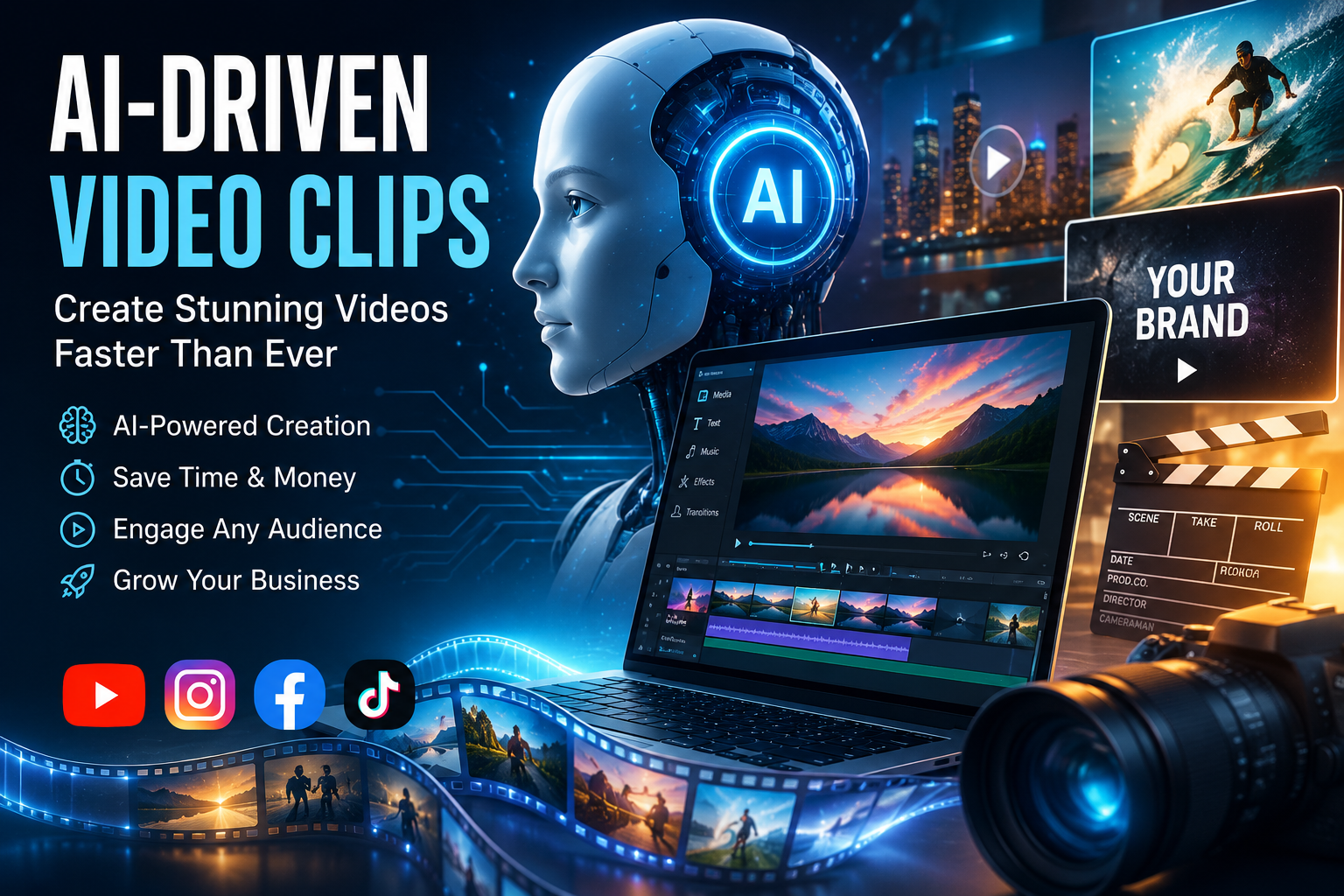
AI-Driven Video Clips: How Artificial Intelligence Is Changing Video Creation
Video used to require cameras, actors, editors, expensive software and hours—or days—of production. AI is changing that fast.
Today, a simple idea typed into an AI platform can become a promotional video, social-media clip, product demonstration or short-form story in minutes.
And for small businesses, this could be one of the most useful applications of AI yet.
From an Idea to a Video in Minutes
Imagine typing:
“Create a 20-second promotional video for a local landscaping company. Show an untidy backyard transforming into a beautiful outdoor entertaining area. Make it energetic, realistic and suitable for Facebook and Instagram.”
An AI video platform can turn instructions like these into moving visual content.
The process is increasingly becoming:
Idea → Prompt → AI Generation → Editing → Voice/Music → Publish
Instead of starting with cameras and a production crew, businesses can start with an idea.
Why AI Video Is Becoming So Powerful
AI-generated video isn’t simply about making unusual animations.
Modern AI tools can help create:
- Promotional clips
- Product demonstrations
- Social-media videos
- YouTube Shorts
- Facebook and Instagram content
- Educational videos
- Explainer videos
- Animated images
- AI presenters and avatars
- Voiceovers
- Marketing campaigns
One business can potentially produce dozens of variations from the same original concept.
A restaurant could promote tonight’s special.
A real-estate agent could transform property photographs into a short promotional video.
A consultant could turn a blog article into several LinkedIn clips.
An online retailer could convert product images into attention-grabbing advertisements.
And a small business could create professional-looking content without maintaining an internal video-production department.
The Real Revolution: AI Understands Instructions
Traditional video editing asks:
“How do I create this?”
AI video creation increasingly asks:
“What do I want to create?”
That is a fundamental change.
You describe the scene, atmosphere, camera movement, audience and purpose. The AI handles more of the technical production.
For example:
“A cinematic close-up of a barista preparing coffee in a modern Australian café, morning sunlight through the windows, customers arriving, warm atmosphere, slow camera movement.”
The quality of the instruction—the prompt—becomes increasingly important.
In other words, creativity doesn’t disappear.
Creativity moves upstream.
AI Video + AI Agents = Something Even Bigger
This is where things become particularly interesting for businesses.
AI video doesn’t have to operate alone.
Imagine an AI marketing agent that can:
identify a topic → write a script → generate images → create a video → generate a voiceover → write the caption → prepare the social post
With human approval before publishing, much of a company’s repetitive content-production workflow could eventually be automated.
That means we’re moving from AI-generated content toward AI-managed content creation.
Small Businesses May Be the Biggest Winners
Large organisations already have marketing departments, designers and production teams.
Small businesses often don’t.
A plumber, accountant, café owner, consultant, online retailer or local tradesperson may know exactly what they want to promote but lack the time or budget to continuously create video content.
AI dramatically lowers that barrier.
Instead of asking:
“Can we afford to produce another video?”
business owners may increasingly ask:
“Which video should we create today?”
That change could dramatically increase the amount of video content produced by small businesses.
But There Is a Catch
AI can generate impressive video, but impressive doesn’t automatically mean effective.
Businesses still need:
a good idea, a clear message, an understanding of their audience and a reason for someone to keep watching.
AI can generate five videos in the time it once took to create one.
It can also generate five boring videos.
The winning combination is therefore unlikely to be AI instead of humans.
It is:
Human creativity + AI production speed.
Businesses should also review AI-generated material carefully for factual accuracy, strange visual artefacts, inappropriate representations, copyright or brand issues and consistency with their own identity before publishing it.
The First Few Seconds Matter
The explosion of AI content creates another problem:
Everyone can create more content.
That means attention becomes even harder to win.
The opening seconds of a video are critical.
Instead of beginning with:
“Welcome to our company…”
try opening with a problem, surprise or question:
“What if your business could answer every customer call—even at 2 AM?”
or:
“This entire video was created by AI.”
The objective isn’t simply to generate a video.
The objective is to make someone stop scrolling.
From Video Production to Video Generation
We are witnessing a major shift.
Photography became digital.
Editing moved to the cloud.
Social media turned everyone into a publisher.
Now artificial intelligence is turning more people into video creators.
The technology will continue improving, but the opportunity already exists.
Businesses that learn how to combine AI, storytelling, automation and human judgement will be able to experiment faster and produce content at a scale that previously required considerably more time and money.
The Camera Is No Longer the Starting Point
Perhaps the most fascinating part of the AI-video revolution is this:
For the first time, you may not need to film something before you can create a video of it.
You can start with an idea.
And increasingly, AI can help turn that idea into something people can watch.
The future of video may begin with just one sentence:
“Create a video about…”
TheBestMediaMakers.com
Leave a Reply